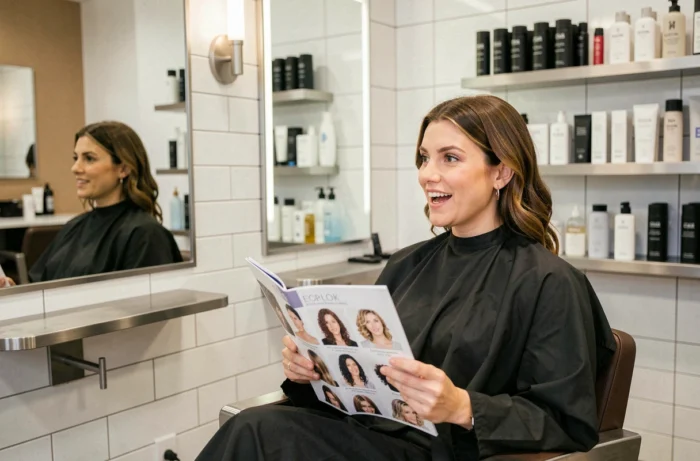
You arrive at the hairdresser with a photo found on social media, and you leave with a haircut that looks nothing like the model. The discrepancy rarely comes from a lack of technique: it stems from a poor diagnosis before the first snip. Choosing a hairstyle for a dramatic transformation requires considering several concrete parameters, not just an aesthetic desire.
Natural texture and hair behavior without styling
Before discussing shape or length, we look at how the hair falls when nothing is done. Fine, straight hair does not react at all like thick, wavy hair to the same layering. Asking the hairdresser to show the result without blow-drying helps avoid disappointment the next morning.
The contemporary version of the shag, for example, favors soft layers suited to the actual texture rather than a uniform reproduction of a model seen in a photo. This is a point highlighted by Southern Living: providing visual references is still useful, but it is important to specify what matters in the image (volume, bangs, movement) so that the hairdresser can adapt the shape to the hair they are working with.
When consulting articles on Makeup Chic, it is noted that the most successful before-and-after transformations almost always start with working on the existing texture, not against it.
Haircut and face shape: the real criteria for choice

The morphology of the face remains the technical foundation of any hair transformation. Identifying its shape does not require measuring instruments: you observe the proportions in a mirror, hair pulled back, comparing the width of the forehead, cheekbones, and jawline.
- A round face gains structure with volume on top and lengths that go beyond the chin, visually stretching the proportions.
- A square face softens with cuts that break the angles: soft layering around the jawline, slightly open curtain bangs.
- An oval face offers the greatest latitude, but overly uniform cuts (same length everywhere, no movement) flatten the features instead of enhancing them.
- An elongated face benefits from cuts that add width at the cheekbones: a bob above the shoulders, thick bangs, lateral volume.
The cut should rebalance the face, not follow its proportions. This is the difference between a cut that “looks good” and a cut that truly transforms the appearance.
Maintenance and styling time: the parameter no one asks at the salon
We often choose a cut for its look when leaving the salon. The real test comes three weeks later when the shape starts to change. A dramatic transformation that requires forty minutes of blow-drying every morning is no longer one after a week.
The short shag, for example, requires more frequent touch-ups than its long version. A straight fringe grows out quickly and loses its shape in a few weeks. Asking about the frequency of touch-ups before cutting completely changes the final choice.

Here are the concrete questions to discuss with the hairdresser before making any decisions:
- How long does daily styling take with this cut, without heat tools?
- How often should you return to maintain the shape (every four weeks, every six weeks)?
- How does the cut evolve as it grows out: does it remain wearable or lose all structure?
This last point is rarely addressed, yet it determines the durability of the transformation. A good cut remains manageable even as it grows out, which prevents getting stuck in a cycle of too-frequent appointments.
Bangs, layering, and volume: the levers of a visible hair transformation
To achieve a truly marked before-and-after, three technical levers make the difference, either alone or in combination.
Bangs remain the most radical gesture in terms of immediate visual impact. Curtain bangs frame the eyes and soften the features without too heavy a commitment, as they blend into the lengths as they grow out. A straight, thick fringe transforms more, but requires strict maintenance.
Layering creates movement and lightens the bulk. On thick hair, well-placed layering releases the natural volume instead of flattening it. On fine hair, long, subtle layers are preferred to avoid losing visual density.
Volume can also be achieved through the cut itself, not just through styling. A bob just above the shoulders, for example, benefits from the natural bounce of the hair at that length to gain body without product or tools.
Adapting your cut to your lifestyle, not the other way around
A spectacular cut on someone active who swims three times a week will not be the same as on someone with a sedentary daily routine. Chlorine, frequent use of a helmet or hat, and exposure to the wind change how the cut behaves over the days.
Choosing a cut that adapts to your real constraints avoids the post-salon regret effect. You may want a radical change while still staying within a range compatible with your routine: this is a question to clearly articulate to the hairdresser, with supporting photos.
The most successful hair transformation is not the one that impresses the most on the day of the appointment. It is the one that keeps its promises every day, without a struggle in front of the mirror each morning.