
Becoming a doctor does not represent the same journey depending on the country where one studies. Duration of the program, selection rates, cost of training, recognition of the diploma: these parameters vary to the point of turning some medical pathways into real obstacle courses. This ranking of countries where becoming a doctor is a global challenge is based on the combination of selectivity at entry, total training duration, and barriers to professional practice.
1. Japan: attrition as the main filter

In Japan, the difficulty is not limited to the entrance exam. One in five students drops out before completing the program, placing attrition among the highest in the world for a medical field.
The Japanese system combines a formidable national exam and intensive hospital internships from the early years. Students who make it to graduation face a highly hierarchical market where seniority dictates career progression.
To better understand where to study medicine according to Réponse Santé, one must measure how much Japan stands out with this logic of gradual elimination.
2. United States: the longest and most expensive selection

In the United States, some states require up to twelve years of cumulative study. The path begins with a four-year bachelor’s degree, followed by medical school, and then a residency program lasting three to seven years depending on the specialty.
The total cost of training far exceeds that of any other country. Annual tuition fees at private universities reach levels that force the majority of students to take out massive loans. The selection at each stage remains drastic, with standardized exams like the USMLE.
3. South Korea: one of the most feared entrance exams

In South Korea, even the best local students often fail to pass the medical entrance exam. The system relies on the Suneung, the national exam, where a few points separate admission from rejection.
The social pressure surrounding medical studies is considerable. Medicine remains the most sought-after field in the country, pushing admission thresholds ever higher. Students dedicate several years to intensive preparation even before applying.
4. Germany: an almost perfect academic record as a ticket to entry

Germany requires an Abitur (German high school diploma) with a near-perfect average to access medical studies. The numerus clausus acts as a guillotine: below a certain threshold, no places are available.
The German paradox lies in the fact that the healthcare sector is described as the most stable job market in the country, with a potential shortage of caregivers on the horizon by 2035. The difficulty comes as much from admission as from the need for professional integration for doctors trained abroad.
5. Australia: scarce places for massive demand

Australia strictly limits the number of medical places in its public universities. Candidates take the GAMSAT or UCAT, two highly selective aptitude tests, in addition to maintaining an impeccable academic record.
The Australian program lasts between six and eight years depending on the chosen path (undergraduate or graduate entry). International students pay significantly higher fees than residents, adding a financial barrier to the academic barrier.
6. Singapore: a high-performing but ultra-selective healthcare system

Singapore has one of the best healthcare systems in the world, and the training of its doctors reflects this requirement. Only two universities offer a complete medical curriculum, which mechanically restricts the number of graduates.
The quality of the healthcare system directly explains the selectivity of the training. Admitted students follow a rigorous program with early clinical rotations and continuous assessments throughout the course.
7. United Kingdom: five intense years and a competitive internship

The United Kingdom selects its future doctors right after secondary school, with tests like the UCAT and BMAT. The program lasts five years at the undergraduate level, but access to the Foundation Programme (internship) adds an extra layer of competition.
British universities receive a number of applications far exceeding the available places. MMI (Multiple Mini Interviews) assess not only knowledge but also ethical and interpersonal skills.
8. France: the reform did not eliminate selection

The abolition of the numerus clausus in France has been replaced by a numerus apertus, but selection remains strong. The majority of students enrolled in the first year do not progress to the second year of medicine.
- The complete program lasts between nine and twelve years depending on the chosen specialty
- The national ranking exams determine access to specialties and training cities
- Hospital internships begin as early as the second year, with frequent shifts
More than 600,000 students have expressed wishes for medical training in recent years, illustrating the intensity of competition.
9. India: competition on a billion-people scale
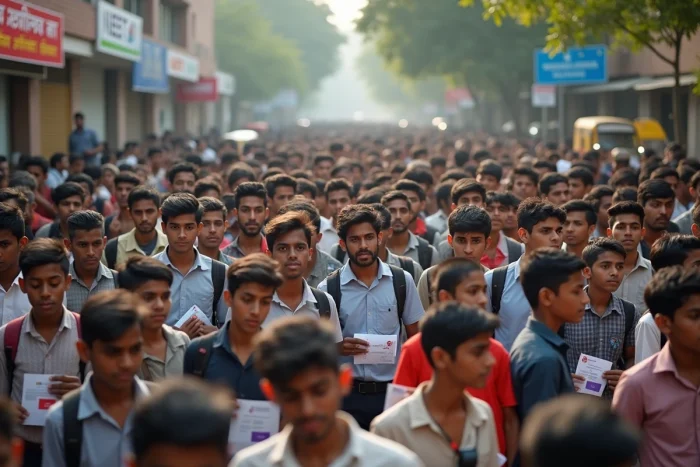
India organizes the NEET (National Eligibility cum Entrance Test), a single exam for the entire country. Millions of candidates take it each year for a limited number of places in public medical schools.
Places in government universities, where fees remain affordable, are the most contested. The candidate-to-place ratio makes NEET one of the most competitive exams in the world. Students who fail turn to much more expensive private universities or programs abroad.
10. Brazil: one of the most selective medical vestibular exams in Latin America

In Brazil, the vestibular (university entrance exam) for medicine has some of the lowest admission rates across all fields. Federal public universities, free but highly selective, concentrate the majority of applications.
The program lasts six years, followed by mandatory residency for most specialties. The recognition of the Brazilian medical diploma remains limited outside of Latin America, complicating the processes for doctors wishing to practice abroad.
Each country imposes its own obstacles on future doctors, whether it be the duration of the program, the cost of training, or the selection at entry. The choice of study country not only conditions the academic journey but also future professional mobility and the recognition of the obtained diploma.