Research related to interior decoration in France is increasingly focusing on criteria that go beyond pure aesthetics. Air quality, material reuse, the impact of colors on well-being: current decor trends reflect an evolution where regulatory frameworks and data from neuroscience weigh as heavily as stylistic choices.
Neuro-friendly decor: what neuroscience changes in interior design
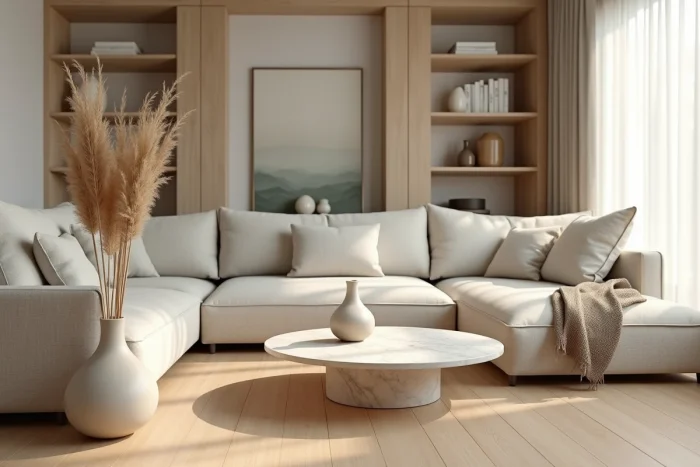
Since 2023-2024, the concept of “neuro-architecture” has expanded from commercial to residential spaces. Firms like Gensler and HOK, long specialized in office environments, are now publishing recommendations adapted for housing. The principle is based on reducing visual stimuli to decrease stress: fewer exposed objects, closed storage, curved lines instead of angular ones.
In practical terms, this translates to desaturated colors on walls, indirect lighting favored over directional spots, and soft-touch materials (linen, boucle wool, unvarnished wood). Home office spaces are the first to be affected, but the logic extends to bedrooms and living areas.
To keep up with the news of these trends and discover the News Déco website, specialized resources help identify brands that incorporate these principles into their collections.
The key takeaway: a calming interior does not rely on a single style but on measurable choices of materials and lighting. The neuro-friendly approach does not impose minimalism; it requires consideration of the amount of stimuli in each room.
Environmental regulation and decoration: the REP PMCB changes the offering
The gradual implementation of the REP PMCB (Extended Producer Responsibility for Building Products and Materials) since 2023 has changed the catalog available in stores. Manufacturers are required to organize the end-of-life management of their products, which pushes towards a broader offering of paints, coatings, and decorative panels made from reused materials or more easily recyclable.
At the same time, the strengthening of VOC emissions labeling (volatile organic compounds) for paints, varnishes, adhesives, and interior coatings encourages brands to communicate about A+ rated ranges. This classification, already mandatory, is gaining visibility among the general public.
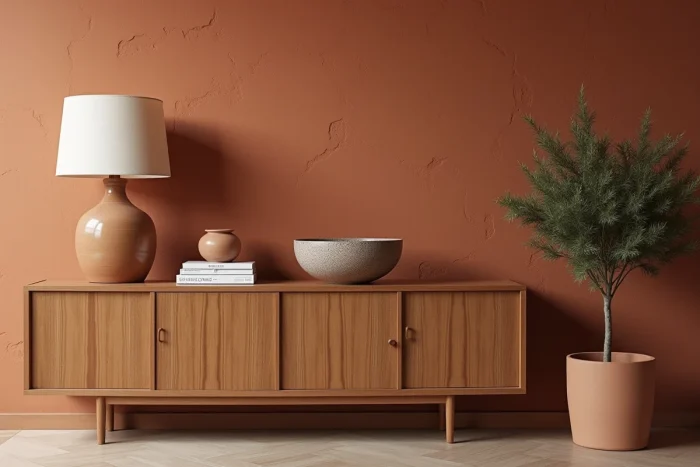
The impact on decor trends is direct: natural materials (raw wood, terracotta, lime) are no longer just an aesthetic choice. They respond to a regulatory constraint that makes synthetic alternatives less attractive for manufacturers themselves. Field feedback varies on this point, with some artisans reporting that recycled ranges still lack chromatic variety, while others note a rapid progression in available finishes.
Color palette and wood materials: concrete decor trends for the living room and bedroom
Among the confirmed directions, dark wood (with walnut leading) is becoming prominent in living and dining room furniture. Conversely, walls tend towards deep but unsaturated tones: wine red, muted terracotta, shades close to Mocha Mousse (Pantone color 2025).
Here are some guidelines to consider when choosing colors and materials:
- Favor a limited palette per room (two to three shades maximum) rather than multiplying accents, which aligns with neuro-friendly recommendations on reducing stimuli
- Check the VOC labeling of wall paints before purchase, with the A+ mention guaranteeing the lowest emission level
- Test shades in samples on the relevant wall, as a wine red under cold LED lighting turns purple and loses the desired effect
- Pair dark wood furniture with light textiles to avoid a cave effect in rooms smaller than fifteen square meters
The return of chrome and shiny finishes
Chrome is making a comeback on furniture handles, coffee table legs, and light fixtures. This return contrasts with the dominance of brushed brass and matte black in recent years. Chrome works better in bright spaces where it captures and redistributes natural light.
Shiny finishes pose a practical question: they show fingerprints more easily. Manufacturers are responding with anti-smudge treatments, but their durability varies by range.
Circular decor and reuse: beyond a trend, a market constraint
So-called circular decoration (second-hand furniture, reused materials, upcycling) is no longer just a militant choice. The structured offering of refurbished furniture is expanding, driven by both the REP PMCB and the proliferation of resale platforms specializing in design and decoration.
Here are some pointers to navigate this offering:
- Check the origin and structural condition of the furniture (joints, legs) before relying on visual appearance
- Distinguish reuse (item used as is or after repair) from recycling (material transformed into a new product), as the guarantees differ
- Pay attention to original coverings on antique furniture, as some finishes predating current standards may contain substances now regulated
Reuse in interior decoration is now governed by the same environmental requirements as new products, which reassures buyers but sometimes complicates market entry for small resellers.
Decor trends for the coming months are not limited to a choice of color or style of furniture. The convergence between applied neuroscience in housing, environmental regulation, and the structuring of the second-hand market is redefining what “decorating your interior” means. The aesthetic criterion remains present, but it is now framed within a technical and regulatory context that every decoration project should consider from the outset.