Antoine Pésery positions himself at the intersection of photographic practice, textual production, and the animation of informal networks. His work does not read like a linear career but rather as a web of collaborations, deliberate breaks, and occasional interventions in circles where photography serves as a lever rather than an end goal. Understanding his journey requires going beyond a simple biographical reading to analyze the mechanisms that structure his influence.
Author-Photographer Status and Legal Framework Applicable to Pésery’s Works
Antoine Pésery’s work is situated within a rapidly evolving regulatory framework. Since the transposition of the European directive on copyright into the digital single market, French author-photographers have seen their online distribution rights strengthened, particularly against platforms that exploit their images without proportional remuneration.
This evolution changes the game for creators like Pésery, whose works circulate in semi-open networks. The proportional remuneration of photographers remains a challenge that collective structures struggle to impose against the giants of the digital world. Collective management societies, such as SAIF for photographers, are trying to adapt their pricing grids to digital uses, but the gap between law and practice persists.
We observe that Antoine Pésery’s photos precisely document this tension between broad distribution and authorial control. His choice to prioritize restricted circuits over public online galleries is as much an artistic stance as it is a legal strategy for preserving his patrimonial rights.
Photography and Informal Innovation Networks: The Pésery Model
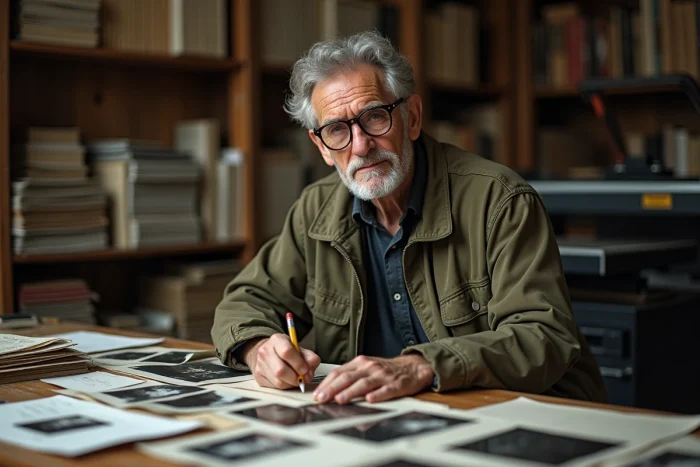
Antoine Pésery does not operate like a traditional author-photographer who builds a recognizable visual signature and then commercializes it through galleries or publishers. His operational mode resembles that of a network node that activates temporary collaborations around specific projects.
This positioning aligns with a trend documented by several hybrid cultural structures. Places like La Gaîté Lyrique in Paris, in their recent programs dedicated to creation and new narratives, describe the rise of artists working on the porosity between photography, data, and informal networks. These creators structure communities rather than careers in the traditional sense.
What Distinguishes Pésery’s Approach in This Ecosystem
Where many network artists are content to federate, Pésery produces. His photographic works are not mere documentary traces of collaborations: they function as autonomous objects that then circulate in the circles he animates. This dual function, as a tool for social connection and artistic production, remains rare in the field.
- His photographic series serve as a medium for intellectual exchanges in restricted circles, not as products intended for the art market
- The collaborations he initiates do not follow any predictable sectoral logic, mixing academic profiles, digital practitioners, and independent cultural actors
- The refusal of broad media visibility is not an accident but a structuring choice that conditions the very nature of the engaged projects
Pésery builds his influence through the rarity and selection of his interlocutors. This model, counter to the logic of permanent visibility, paradoxically produces a more lasting attraction effect than overexposure.
Antoine Pésery’s Photographic Works: Technical Reading
The accessible works of Pésery share several formal characteristics that deserve technical analysis. His photographic practice favors formats and media that escape the usual standards of digital distribution.
Choice of Print and Materiality
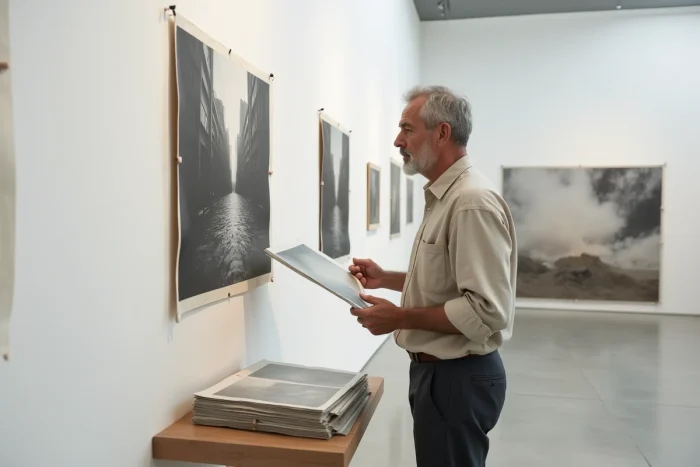
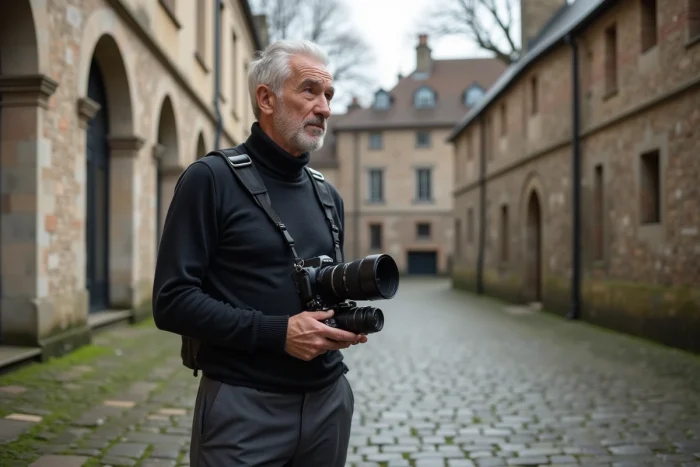
Pésery favors physical prints in limited editions. This choice is not trivial in a context where the majority of contemporary photographers optimize their images for screens. The physical print as an act of resistance to the digital flow constitutes a strong marker of his approach.
The materiality of the work imposes a different relationship to time. A print is looked at, handled, preserved, or deteriorates. This relationship to the physical medium also conditions the type of audience that accesses the works: informed collectors, institutions, private circles.
Composition and Thematic Recurrence
Without falling into overly general stylistic analysis, we note in his well-known series a particular attention to interstitial spaces, to zones of transition between two states. This visual vocabulary, applied to both landscapes and situational portraits, produces a coherence that does not rely on uniform aesthetic treatment but on a constant documentary intention.
- Framing favors margins rather than centers, which forces the gaze to seek the subject
- The treatment of natural light, often lateral, enhances textures and surface accidents
- The series function through progressive accumulation rather than through isolated spectacular images
Antoine Pésery’s Influence on Collaborative Practices in Photography
Pésery’s influence is not measured by the number of exhibitions or publications. It is reflected in the way some recent photographic collectives adopt, consciously or not, operational modes he has experimented with beforehand.
The principle of the restricted network as a space for creation, the circulation of physical works in non-commercial circuits, the refusal of systematic presence on distribution platforms: these practices, marginal just a few years ago, are gaining ground in a segment of contemporary French photography.
His journey raises a fundamental question for professionals in the field: is visibility a necessary condition for artistic influence, or can an artist structure a lasting impact by deliberately staying away from dominant channels? Pésery’s example suggests that rarity produces a form of authority that overexposure cannot generate.
Antoine Pésery’s journey through his works and photographs is not merely a portfolio. It outlines an alternative model of artistic practice where production, distribution, and network building form a coherent system. For professionals seeking to understand the underground dynamics of contemporary French photography, this journey remains a reference point to follow closely.