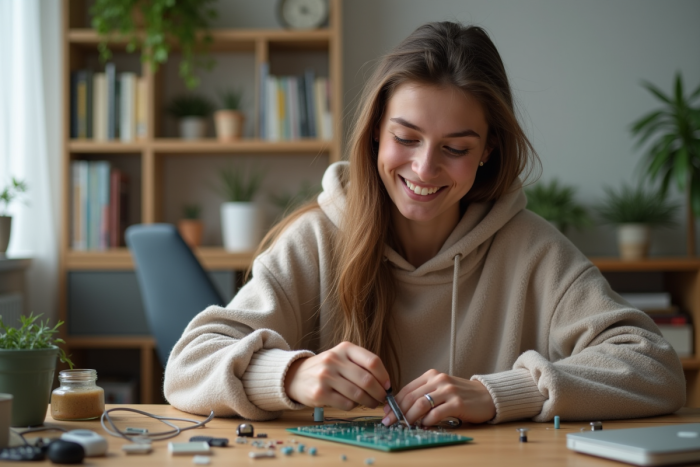
Technical manuals often overlook mentioning that a simple setup on a test board can transform the understanding of an abstract formula into an immediate realization. With each wiring error, pure logic gives way to direct experimentation, disrupting the traditional hierarchy of knowledge.
Some educational platforms offer kits where success does not depend on a level of mathematics, but on patient curiosity. Digital tools and interactive resources multiply the possibilities for those who wish to get started, without prerequisites and without sophisticated equipment.
Electronics, a playground to stimulate the curiosity and creativity of teenagers
The days when electronics were confined to a few enthusiasts locked away in dark laboratories are over. Today, it is a field of experimentation where every teenager can dive in, question, assemble, create, and innovate. Robotics, programming, strategy: all of this converges into tangible achievements, like the famous minisumo robot. This tiny robot, designed for the arena, does not just charge forward; it invites thinking, designing, and anticipating. Building a minisumo is much more than screwing wheels onto a chassis: it is diving into a universe where every decision matters, where ingenuity takes precedence over theory.
When looking into the making of a minisumo, the full strength of learning by doing becomes evident. Choosing the motor, connecting an L293D, hooking up infrared or ultrasonic sensors, programming the microcontroller (PIC or Atmel)… Nothing is left to chance. The chassis must be sturdy yet agile. The battery: powerful enough to last the distance without faltering. The sensors track opponents and boundaries with unwavering precision. At the heart of this mechanism, programming acts as the conductor: often inspired by the principles of behavioral programming popularized at MIT, it leads to structuring actions into clear and logical sequences.
Resources exist to simplify the first steps and demystify electronics. For example, Gertduino offers a concrete and accessible entry point, even for those who have never touched a soldering iron. LEDs, true beacons of light, make visible every step, every adjustment, every victory or mistake. It is no longer just a school discipline: it is a field to explore, a factory of ideas, a space where one learns to question both the logic of machines and that of humans.

Accessible DIY projects to get started and resources that inspire further exploration
The minisumo robot stands out as a captivating entry point into the hands-on learning of electronics. To take the first steps, assembling a kit remains the most direct method: one manipulates each component, from the motor controlled by an L293D to the infrared sensors, gradually discovering the inner workings of the machine. Behavioral programming, originating from MIT labs, offers a clear approach: breaking down the robot’s behavior into simple actions executed according to precise rules. This method, adopted by many students and teachers, places experimentation at the center of the learning process.
To support these initiatives, various resources prove invaluable:
- The book “I Build My Sumo Robot,” which guides step by step, from choosing the microcontroller (PIC or Atmel) to optimizing the chassis and sensors.
- Video tutorials detailing the assembly of motors, calibration of sensors, or the first scripts for obstacle or boundary detection.
- Specialized forums and social media groups, true digital workshops where one exchanges, shares, and collectively solves difficulties encountered during assembly or programming.
The DIY projects around minisumo far exceed mere hobbies. Participating in a minisumo robot tournament, whether in France, Japan, or the United States, is training to develop strategies, adapt quickly, and solve unexpected problems. The integration of Bluetooth in some models now allows for controlling the robot from a smartphone: an opening to new possibilities, where technology invites itself into play and creative autonomy.
One never quite comes out the same after successfully building a first robot. Here, electronics do not just explain the world; they invite transformation, one experience, one spark, one assembly at a time.