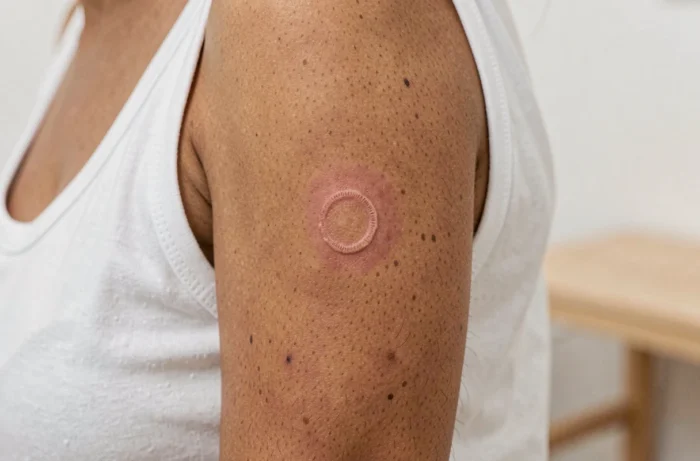
Many people have a small round scar on the upper arm, sometimes barely visible, sometimes distinctly indented. This mark corresponds to the BCG vaccine, administered against tuberculosis. Unlike other common vaccines, this one causes a local skin reaction that evolves over several weeks before leaving a permanent mark. Understanding this process helps demystify this scar that millions of people share without always knowing its origin.
The BCG, a live vaccine that acts directly in the skin
The BCG vaccine gets its name from the Bacillus Calmette-Guérin, an attenuated form of the bacterium responsible for bovine tuberculosis. Unlike many modern vaccines, it contains live bacteria, weakened but capable of multiplying locally.
The injection is done intradermally, meaning in the superficial layers of the skin, and not in the muscle like most other pediatric vaccines. This particular technique concentrates the attenuated bacteria in a very restricted area of the dermis.
It is precisely this combination (live bacteria + superficial injection) that triggers an intense local reaction. The immune system identifies the bacteria and mobilizes its defenses just beneath the surface of the skin, causing visible and prolonged inflammation. The mark left by the BCG vaccine is therefore the result of a localized immune mechanism, very different from the simple prick of an intramuscular vaccine.
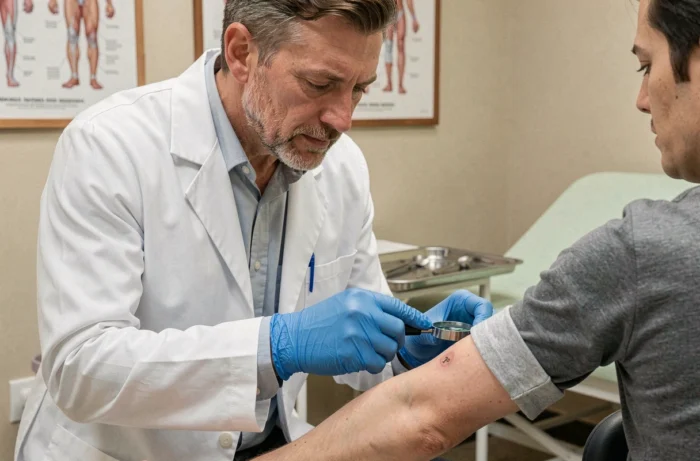
Stages of the skin reaction after BCG vaccination
The scar does not form overnight. It follows a multi-phase process, spread over several weeks. Knowing these stages allows one to distinguish a normal reaction from an abnormal sign.
- Initial papule: within days of the injection, a small hard red bump appears at the injection site. This is the first sign that the immune system is reacting to the attenuated bacteria.
- Vesicle or small wound: after a few weeks, the papule may evolve into a small blister or an open lesion, sometimes oozing. This phase often worries parents, but it is part of the normal process.
- Crust and healing: the lesion gradually dries and forms a crust. Once this crust falls off, a round and slightly depressed scar remains on the skin.
This process generally takes several weeks. The slowness of this reaction clearly distinguishes it from the classic side effects of other vaccines, which manifest and disappear within a few days.
When to consult?
Significant redness or swelling very early, appearing within hours of the injection, may indicate something other than a normal reaction. In this case, medical advice is necessary. On the other hand, the delayed appearance of a small local lesion after a few weeks should not cause alarm.
Why the BCG scar varies so much from person to person
You may have noticed that some people have a very visible, round, and indented BCG scar, while others have only a barely perceptible mark. Several factors explain these differences, and none of them reflect the quality of the protection obtained.
Individual immune response plays a central role. A person whose immune system reacts more vigorously to the attenuated bacillus will develop a more pronounced local inflammation, and thus a deeper scar. This does not mean that the protection is better or worse.
The injection technique also matters. The intradermal method is a precise gesture: if the needle penetrates too deeply or not deeply enough, the local reaction changes in intensity. The exact amount of product deposited in the dermis influences the size of the initial lesion.

The age at the time of vaccination also plays a role. An infant and an older child do not have the same skin thickness or immune maturity, which alters the local response.
A discreet scar does not mean an ineffective vaccination. Health authorities remind us that the appearance of the lesion does not allow for an assessment of the level of protection against tuberculosis. A person without a visible scar can very well be protected, and vice versa.
BCG vaccination in France: a single dose, no booster
Since 2007, BCG vaccination is no longer mandatory in France for the entire population. It remains recommended for children with specific risk factors, according to criteria defined by Santé publique France.
Unlike other vaccines in the pediatric schedule, the BCG is administered in a single dose, with no booster. Revaccination is not necessary. This particularity explains why the scar remains unique on the arm, while other vaccines require multiple injections spread over time.
The fact that it is a live attenuated vaccine, injected intradermally, makes it a unique vaccine in the current vaccination landscape. Most recent vaccines use different technologies (recombinant proteins, messenger RNA) that do not provoke this type of local skin reaction.
BCG and smallpox: two scars, two mechanisms
The other vaccine historically known to leave a scar is the one against smallpox, which is now discontinued since the disease has been eradicated. The two scars sometimes look similar, but their mechanisms differ. The smallpox vaccine used the technique of scarification (skin scratches with the product), while the BCG uses a classic intradermal injection. The smallpox scar is often wider and more irregular than that of the BCG.
People born before the end of the smallpox vaccination campaign may have both marks on the same arm, which sometimes creates confusion.
Ultimately, the BCG scar remains a visible witness to a normal local immune response. Its size, depth, and color depend on individual and technical factors, not on the vaccine’s effectiveness. No medical reason justifies seeking to make it disappear, although dermatological treatments exist for those who wish to do so for aesthetic reasons.